Public-safe resume

Public-safe resume signal for platform ownership and governed architecture.

A structured public-safe resume view for global OT platform ownership, regulated infrastructure leadership, lifecycle governance, recovery posture, and source-grounded AI architecture.

This route keeps the resume signal structured without exposing employer-sensitive details, compensation content, or private source records.

  • Global OT platform ownership
  • Regulated operations
  • Recovery and evidence
  • Governed AI

Executive summary

Senior Manager and global OT platform owner bridging enterprise IT and operational technology.

Public-safe resume signal for regulated manufacturing, labs, logistics, and controlled operational environments. Leads platform engineering where uptime, validation state, cyber posture, lifecycle governance, recovery, supplier execution, and evidence readiness matter.

Current-title wording remains Senior Manager. Broader leadership language is used as scope calibration for external conversations, not as a claim of current title.

17k+Public-safe Windows OT workstation scale referenced in approved derivative material.
500+Ubuntu systems in regulated operational platform scope.
150+Site-scale operating model across controlled environments.
3kTransition-pattern experience for OT workstations across a major separation boundary.

Platform ownership scope

Global service ownership, not narrow endpoint administration.

Service model

Own direction for workstation and endpoint services in regulated operational environments, including standards, support posture, lifecycle patterns, and operational continuity.

Operating model

Lead across people, process, vendors, contractors, offshore execution, depot patterns, service governance, and practical field support.

Control boundary

Own infrastructure/platform controls while not claiming ownership of all business validation, quality authority, regulatory interpretation, or application ownership.

Continuity

Balance uptime, lifecycle timing, cyber posture, supplier execution, recovery readiness, and reviewable evidence.

Regulated OT and infrastructure leadership

Infrastructure work inside controlled environments has a different risk model.

Experience spans manufacturing, labs, logistics, and related operational environments where endpoints are tied to validated processes, supplier systems, quality expectations, cyber controls, and business continuity. The work is technical, but the leadership burden is making the whole environment governable.

  • IT/OT translationConvert enterprise standards into controls that operational environments can actually run.
  • Qualified constraintsRespect validation posture, maintenance windows, vendor limitations, and evidence expectations.
  • Global supportDesign support paths for heterogeneous fleets, site variation, supplier execution, and recovery pressure.

Lifecycle governance

Standards, exceptions, refresh, and change boundaries.

OS baseline governance

Windows LTSC, Windows IoT LTSC, and Ubuntu LTS patterns for controlled endpoint environments.

Hardware and vendor standards

Workstation patterns that account for supplier constraints, site reality, hardening, and supportability.

Patch and drift posture

Patch readiness, exception handling, observability, and drift detection as governance signals.

Transition planning

Modernization and lifecycle movement across management, security, backup, telemetry, and service tooling.

Automation and observability

Automation with restraint, evidence, and reviewability.

Automation is useful when it reduces friction, improves repeatability, strengthens evidence, and exposes drift. It is not useful when it turns regulated operations into an experiment.

  • Controlled configuration checks
  • Evidence generation
  • Telemetry and dashboards
  • Data engineering for service insight
  • Drift detection
  • Toolchain integration

Recovery and evidence posture

Restore, prove, audit, and support the platform when it matters.

Public-safe work examples include reducing a regulated workstation qualification and delivery cycle from weeks to hours through controlled automation and preserving validated state across a large OT workstation transition where rebuild would have increased risk and disruption.

The point is not the anecdote. The point is the operating discipline: make the platform recoverable, make the claim reviewable, and keep accountability visible.

Governed AI architecture

AI capability with source authority and human review.

Architecture positioning is governance-first: source authority, context portability, evaluation, bounded behavior, decision boundaries, review gates, and accountable human judgment.

The safe lane is advisory-only and assistive-only patterns that improve expert work without claiming autonomous production mutation, official enterprise platform status, or unapproved private-lab deployment.

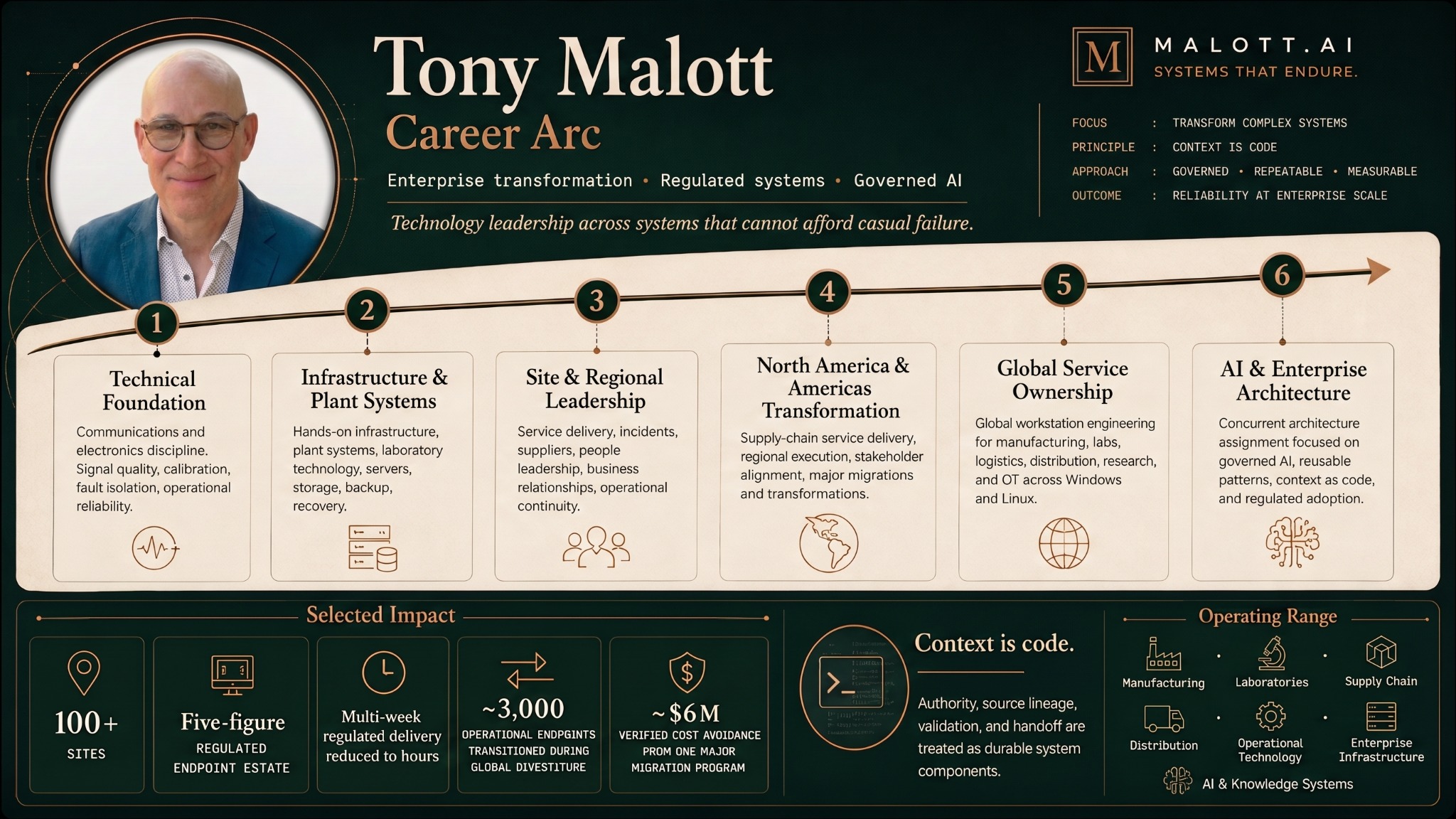
Selected career arc

  1. Systems foundationCommunications and electronics discipline built an early base in operational reliability and troubleshooting.
  2. Infrastructure depthEnterprise infrastructure and endpoint engineering sharpened operating-system, tooling, recovery, automation, and support-model depth.
  3. Regulated OT leadershipWork expanded into operational technology environments where infrastructure has to align with quality, validation, suppliers, and continuity.
  4. Global platform ownershipPublic-safe framing centers on standards, governance, lifecycle patterns, supplier execution paths, and support models across a regulated OT workstation estate.
  5. Governed AI architectureThe same discipline now informs source-grounded assistant and control-plane patterns.

Capability matrix

PlatformOS baselines, endpoint services, workstation engineering, hardening, lifecycle, supportability.
OperationsService governance, supplier execution, depot patterns, continuity, exception handling.
RiskCyber posture, recovery, evidence readiness, validation-state awareness, controlled change.
AISource authority, evaluation gates, bounded behavior, context portability, human accountability.

Public-safe competencies

  • Global OT platform engineering
  • IT/OT operating model design
  • Endpoint lifecycle governance
  • GxP, GAMP 5, Annex 11, 21 CFR Part 11, and 21 CFR Part 211 awareness
  • NIST-aligned cyber posture
  • Workstation engineering services
  • OS baseline governance
  • Patch governance
  • Backup and recovery
  • Operational continuity
  • Governed AI architecture

Continue

Review the public-safe surface

Public-safe profile derived from reviewed career materials. Claims are staged from source-governed review records. Private source material, compensation content, employer-sensitive details, and family/location details are excluded. Privacy boundary.